Genesis 40- July 15,2024 , Aug. 6 Genesis 40:12 -
Ephesians 4:15
New International Version
15 Instead, speaking the truth in love, we will grow to become in every respect the mature body of him who is the head, that is, Christ.
Genesis 40
New International Version
The Cupbearer and the Baker
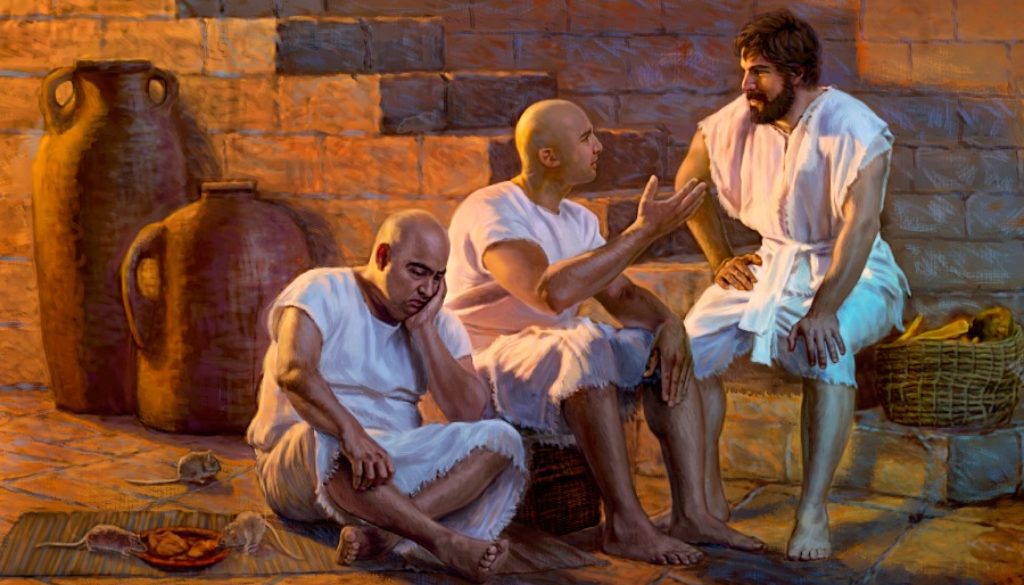
1 Some time later, the cupbearer and the baker of the king of Egypt offended their master, the king of Egypt. 2 Pharaoh was angry with his two officials, the chief cupbearer and the chief baker, 3 and put them in custody in the house of the captain of the guard, in the same prison where Joseph was confined. 4 The captain of the guard assigned them to Joseph, and he attended them.
After they had been in custody for some time, 5 each of the two men—the cupbearer and the baker of the king of Egypt, who were being held in prison—had a dream the same night, and each dream had a meaning of its own.
6 When Joseph came to them the next morning, he saw that they were dejected. 7 So he asked Pharaoh’s officials who were in custody with him in his master’s house, “Why do you look so sad today?”
8 “We both had dreams,” they answered, “but there is no one to interpret them.”
Then Joseph said to them, “Do not interpretations belong to God? Tell me your dreams.”
9 So the chief cupbearer told Joseph his dream. He said to him, “In my dream I saw a vine in front of me, 10 and on the vine were three branches. As soon as it budded, it blossomed, and its clusters ripened into grapes. 11 Pharaoh’s cup was in my hand, and I took the grapes, squeezed them into Pharaoh’s cup and put the cup in his hand.”
12 “This is what it means,” Joseph said to him. “The three branches are three days. 13 Within three days Pharaoh will lift up your head and restore you to your position, and you will put Pharaoh’s cup in his hand, just as you used to do when you were his cupbearer. 14 But when all goes well with you, remember me and show me kindness; mention me to Pharaoh and get me out of this prison. 15 I was forcibly carried off from the land of the Hebrews, and even here I have done nothing to deserve being put in a dungeon.”
16 When the chief baker saw that Joseph had given a favorable interpretation, he said to Joseph, “I too had a dream: On my head were three baskets of bread.[a] 17 In the top basket were all kinds of baked goods for Pharaoh, but the birds were eating them out of the basket on my head.”
18 “This is what it means,” Joseph said. “The three baskets are three days. 19 Within three days Pharaoh will lift off your head and impale your body on a pole. And the birds will eat away your flesh.”
20 Now the third day was Pharaoh’s birthday, and he gave a feast for all his officials. He lifted up the heads of the chief cupbearer and the chief baker in the presence of his officials: 21 He restored the chief cupbearer to his position, so that he once again put the cup into Pharaoh’s hand— 22 but he impaled the chief baker, just as Joseph had said to them in his interpretation.
23 The chief cupbearer, however, did not remember Joseph; he forgot him.
--------------------------------------------------------------------
Genesis 41
New International Version
Pharaoh’s Dreams
1 When two full years had passed, Pharaoh had a dream: He was standing by the Nile, 2 when out of the river there came up seven cows, sleek and fat, and they grazed among the reeds. 3 After them, seven other cows, ugly and gaunt, came up out of the Nile and stood beside those on the riverbank. 4 And the cows that were ugly and gaunt ate up the seven sleek, fat cows. Then Pharaoh woke up.
5 He fell asleep again and had a second dream: Seven heads of grain, healthy and good, were growing on a single stalk. 6 After them, seven other heads of grain sprouted—thin and scorched by the east wind. 7 The thin heads of grain swallowed up the seven healthy, full heads. Then Pharaoh woke up; it had been a dream.
8 In the morning his mind was troubled, so he sent for all the magicians and wise men of Egypt. Pharaoh told them his dreams, but no one could interpret them for him.
9 Then the chief cupbearer said to Pharaoh, “Today I am reminded of my shortcomings. 10 Pharaoh was once angry with his servants, and he imprisoned me and the chief baker in the house of the captain of the guard. 11 Each of us had a dream the same night, and each dream had a meaning of its own. 12 Now a young Hebrew was there with us, a servant of the captain of the guard. We told him our dreams, and he interpreted them for us, giving each man the interpretation of his dream. 13 And things turned out exactly as he interpreted them to us: I was restored to my position, and the other man was impaled.”
14 So Pharaoh sent for Joseph, and he was quickly brought from the dungeon. When he had shaved and changed his clothes, he came before Pharaoh.
15 Pharaoh said to Joseph, “I had a dream, and no one can interpret it. But I have heard it said of you that when you hear a dream you can interpret it.”
16 “I cannot do it,” Joseph replied to Pharaoh, “but God will give Pharaoh the answer he desires.”
17 Then Pharaoh said to Joseph, “In my dream I was standing on the bank of the Nile, 18 when out of the river there came up seven cows, fat and sleek, and they grazed among the reeds. 19 After them, seven other cows came up—scrawny and very ugly and lean. I had never seen such ugly cows in all the land of Egypt. 20 The lean, ugly cows ate up the seven fat cows that came up first. 21 But even after they ate them, no one could tell that they had done so; they looked just as ugly as before. Then I woke up.
22 “In my dream I saw seven heads of grain, full and good, growing on a single stalk. 23 After them, seven other heads sprouted—withered and thin and scorched by the east wind. 24 The thin heads of grain swallowed up the seven good heads. I told this to the magicians, but none of them could explain it to me.”
25 Then Joseph said to Pharaoh, “The dreams of Pharaoh are one and the same. God has revealed to Pharaoh what he is about to do. 26 The seven good cows are seven years, and the seven good heads of grain are seven years; it is one and the same dream. 27 The seven lean, ugly cows that came up afterward are seven years, and so are the seven worthless heads of grain scorched by the east wind: They are seven years of famine.
28 “It is just as I said to Pharaoh: God has shown Pharaoh what he is about to do. 29 Seven years of great abundance are coming throughout the land of Egypt, 30 but seven years of famine will follow them. Then all the abundance in Egypt will be forgotten, and the famine will ravage the land. 31 The abundance in the land will not be remembered, because the famine that follows it will be so severe. 32 The reason the dream was given to Pharaoh in two forms is that the matter has been firmly decided by God, and God will do it soon.
33 “And now let Pharaoh look for a discerning and wise man and put him in charge of the land of Egypt. 34 Let Pharaoh appoint commissioners over the land to take a fifth of the harvest of Egypt during the seven years of abundance. 35 They should collect all the food of these good years that are coming and store up the grain under the authority of Pharaoh, to be kept in the cities for food. 36 This food should be held in reserve for the country, to be used during the seven years of famine that will come upon Egypt, so that the country may not be ruined by the famine.”
37 The plan seemed good to Pharaoh and to all his officials. 38 So Pharaoh asked them, “Can we find anyone like this man, one in whom is the spirit of God[a]?”
39 Then Pharaoh said to Joseph, “Since God has made all this known to you, there is no one so discerning and wise as you. 40 You shall be in charge of my palace, and all my people are to submit to your orders. Only with respect to the throne will I be greater than you.”
Joseph in Charge of Egypt
41 So Pharaoh said to Joseph, “I hereby put you in charge of the whole land of Egypt.” 42 Then Pharaoh took his signet ring from his finger and put it on Joseph’s finger. He dressed him in robes of fine linen and put a gold chain around his neck. 43 He had him ride in a chariot as his second-in-command,[b] and people shouted before him, “Make way[c]!” Thus he put him in charge of the whole land of Egypt.
44 Then Pharaoh said to Joseph, “I am Pharaoh, but without your word no one will lift hand or foot in all Egypt.” 45 Pharaoh gave Joseph the name Zaphenath-Paneah and gave him Asenath daughter of Potiphera, priest of On,[d] to be his wife. And Joseph went throughout the land of Egypt.
46 Joseph was thirty years old when he entered the service of Pharaoh king of Egypt. And Joseph went out from Pharaoh’s presence and traveled throughout Egypt. 47 During the seven years of abundance the land produced plentifully. 48 Joseph collected all the food produced in those seven years of abundance in Egypt and stored it in the cities. In each city he put the food grown in the fields surrounding it. 49 Joseph stored up huge quantities of grain, like the sand of the sea; it was so much that he stopped keeping records because it was beyond measure.
50 Before the years of famine came, two sons were born to Joseph by Asenath daughter of Potiphera, priest of On. 51 Joseph named his firstborn Manasseh[e] and said, “It is because God has made me forget all my trouble and all my father’s household.” 52 The second son he named Ephraim[f] and said, “It is because God has made me fruitful in the land of my suffering.”
53 The seven years of abundance in Egypt came to an end, 54 and the seven years of famine began, just as Joseph had said. There was famine in all the other lands, but in the whole land of Egypt there was food. 55 When all Egypt began to feel the famine, the people cried to Pharaoh for food. Then Pharaoh told all the Egyptians, “Go to Joseph and do what he tells you.”
56 When the famine had spread over the whole country, Joseph opened all the storehouses and sold grain to the Egyptians, for the famine was severe throughout Egypt. 57 And all the world came to Egypt to buy grain from Joseph, because the famine was severe everywhere.
------------------------------------------------------------------
Proverbs 18:19 NASB
A brother who is offended is harder to be won than a strong city, And quarrels are like the bars of a citadel.
-------------------------------------------------------
Philippians 2
Timothy and Epaphroditus
19 I hope in the Lord Jesus to send Timothy to you soon, that I also may be cheered when I receive news about you. 20 I have no one else like him, who will show genuine concern for your welfare. 21 For everyone looks out for their own interests, not those of Jesus Christ. 22 But you know that Timothy has proved himself, because as a son with his father he has served with me in the work of the gospel. 23 I hope, therefore, to send him as soon as I see how things go with me. 24 And I am confident in the Lord that I myself will come soon.
25 But I think it is necessary to send back to you Epaphroditus, my brother, co-worker and fellow soldier, who is also your messenger, whom you sent to take care of my needs. 26 For he longs for all of you and is distressed because you heard he was ill. 27 Indeed he was ill, and almost died. But God had mercy on him, and not on him only but also on me, to spare me sorrow upon sorrow. 28 Therefore I am all the more eager to send him, so that when you see him again you may be glad and I may have less anxiety. 29 So then, welcome him in the Lord with great joy, and honor people like him, 30 because he almost died for the work of Christ. He risked his life to make up for the help you yourselves could not give me.Romans 16
New International Version
Personal Greetings
1 I commend to you our sister Phoebe, a deacon[a][b] of the church in Cenchreae. 2 I ask you to receive her in the Lord in a way worthy of his people and to give her any help she may need from you, for she has been the benefactor of many people, including me.
3 Greet Priscilla[c] and Aquila, my co-workers in Christ Jesus. 4 They risked their lives for me. Not only I but all the churches of the Gentiles are grateful to them.
5 Greet also the church that meets at their house.
Greet my dear friend Epenetus, who was the first convert to Christ in the province of Asia.
6 Greet Mary, who worked very hard for you.
7 Greet Andronicus and Junia, my fellow Jews who have been in prison with me. They are outstanding among[d] the apostles, and they were in Christ before I was.
8 Greet Ampliatus, my dear friend in the Lord.
9 Greet Urbanus, our co-worker in Christ, and my dear friend Stachys.
10 Greet Apelles, whose fidelity to Christ has stood the test.
Greet those who belong to the household of Aristobulus.
11 Greet Herodion, my fellow Jew.
Greet those in the household of Narcissus who are in the Lord.
12 Greet Tryphena and Tryphosa, those women who work hard in the Lord.
Greet my dear friend Persis, another woman who has worked very hard in the Lord.
13 Greet Rufus, chosen in the Lord, and his mother, who has been a mother to me, too.
14 Greet Asyncritus, Phlegon, Hermes, Patrobas, Hermas and the other brothers and sisters with them.
15 Greet Philologus, Julia, Nereus and his sister, and Olympas and all the Lord’s people who are with them.
16 Greet one another with a holy kiss.
All the churches of Christ send greetings.
17 I urge you, brothers and sisters, to watch out for those who cause divisions and put obstacles in your way that are contrary to the teaching you have learned. Keep away from them. 18 For such people are not serving our Lord Christ, but their own appetites. By smooth talk and flattery they deceive the minds of naive people. 19 Everyone has heard about your obedience, so I rejoice because of you; but I want you to be wise about what is good, and innocent about what is evil.
20 The God of peace will soon crush Satan under your feet.
The grace of our Lord Jesus be with you.
21 Timothy, my co-worker, sends his greetings to you, as do Lucius, Jason and Sosipater, my fellow Jews.
22 I, Tertius, who wrote down this letter, greet you in the Lord.
23 Gaius, whose hospitality I and the whole church here enjoy, sends you his greetings.
Erastus, who is the city’s director of public works, and our brother Quartus send you their greetings. [24] [e]
25 Now to him who is able to establish you in accordance with my gospel, the message I proclaim about Jesus Christ, in keeping with the revelation of the mystery hidden for long ages past, 26 but now revealed and made known through the prophetic writings by the command of the eternal God, so that all the Gentiles might come to the obedience that comes from[f] faith— 27 to the only wise God be glory forever through Jesus Christ! Amen.
Matthew Henry :: Commentary on Genesis 40
Chapter 40
In this chapter things are working, though slowly, towards Joseph's advancement.
- I. Two of Pharaoh's servants are committed to prison, and there to Joseph's care, and so become witnesses of his extraordinary conduct (v. 1-4).
- II. They dreamed each of them a dream, which Joseph interpreted (v. 5-19), and the event verified the interpretation (v. 20-22), and so they became witnesses of his extraordinary skill.
- III. Joseph recommends his case to one of them, whose preferment he foresaw (v. 14, 15), but in vain (v. 23).
We should not have had this story of Pharaoh's butler and baker recorded in scripture if it had not been serviceable to Joseph's preferment. The world stands for the sake of the church, and is governed for its good. Observe,
- 1. Two of the great officers of Pharaoh's court, having offended the king, are committed to prison. Note, High places are slippery places; nothing more uncertain than the favour of princes. Those that make God's favour their happiness, and his service their business, will find him a better Master than Pharaoh was, and not so extreme to mark what they do amiss. Many conjectures there are concerning the offence of these servants of Pharaoh; some make it no less than an attempt to take away his life, others no more than the casual lighting of a fly into his cup and a little sand into his bread. Whatever it was, Providence by this means brought them into the prison where Joseph was.
- 2. The captain of the guard himself, who was Potiphar, charged Joseph with them (v. 4), which intimates that he began now to be reconciled to him, and perhaps to be convinced of his innocence, though he durst not release him for fear of disobliging his wife. John Baptist must lose his head, to please Herodias.
Observe,
- I. The special providence of God, which filled the heads of these two prisoners with unusual dreams, such as made extraordinary impressions upon them, and carried with them evidences of a divine origin, both in one night. Note, God has immediate access to the spirits of men, which he can make serviceable to his own purposes whenever he pleases, quite beyond the intention of those concerned. To him all hearts are open, and anciently he spoke not only to his own people, but to others, in dreams, Job 33:15. Things to come were thus foretold, but very obscurely.
- II. The impression which was made upon these prisoners by their dreams (v. 6): They were sad. It was not the prison that made them sad (they were pretty well used to that, and perhaps lived jovially there), but the dream. Note, God has more ways than one to sadden the spirits of those that are to be made sad. Those sinners that are hardy enough under outward troubles, and will not yield to them, yet God can find out a way to punish; he can take off their wheels, by wounding their spirits, and laying loads upon them.
-
III. Joseph's great tenderness and compassion towards them. He enquired with concern, Wherefore look you so sadly to-day? v. 7.
Joseph was their keeper, and in that office he was mild. Note, It
becomes us to take cognizance of the sorrows even of those that are
under our check. Joseph was their companion in tribulation, he was now a
prisoner with them, and had been a dreamer too. Note, Communion in
sufferings helps to work compassion towards those that do suffer. Let us
learn hence,
- 1. To concern ourselves in the sorrows and troubles of others, and to enquire into the reason of the sadness of our brethren's countenances; we should be often considering the tears of the oppressed, Eccl. 4:1. It is some relief to those that are in trouble to be taken notice of.
- 2. To enquire into the causes of our own sorrow, "Wherefore do I look so sadly? Is there a reason? Is it a good reason? Is there not a reason for comfort sufficient to balance it, whatever it is? Why art thou cast down, O my soul?"
-
IV. The dreams themselves, and the interpretation of them. That
which troubled these prisoners was that being confined they could not
have recourse to the diviners of Egypt who pretended to interpret
dreams: There is no interpreter here in the prison, v. 8.
Note, There are interpreters which those that are in prison and sorrow
should wish to have with them, to instruct them in the meaning and
design of Providence (Elihu alludes to such, when he says, If there be an interpreter, one among a thousand, to show unto man his uprightness, Job 33:23, 24), interpreters to guide their consciences, not to satisfy their curiosity. Joseph hereupon directed them which way to look: Do not interpretations belong to God?
He means the God whom he worshipped, to the knowledge of whom he
endeavours hereby to lead them. Note, It is God's prerogative to foretel
things to come, Isa. 46:10.
He must therefore have the praise of all the gifts of foresight which
men have, ordinary or extraordinary. Joseph premises a caveat against
his own praise, and is careful to transmit the glory to God, as Daniel, ch. 2:30.
Joseph suggests, "If interpretations belong to God, he is a free agent,
and may communicate the power to whom he pleases, and therefore tell me
your dreams." Now,
- 1. The chief butler's dream was a happy presage of his enlargement, and re-advancement, within three days; and so Joseph explained it to him, v. 12, 13. Probably it had been usual with him to press the full-ripe grapes immediately into Pharaoh's cup, the simplicity of that age not being acquainted with the modern arts of making the wine fine. Observe, Joseph foretold the chief butler's deliverance, but he did not foresee his own. He had long before dreamt of his own honour, and the obeisance which his brethren should do to him, with the remembrance of which he must now support himself, without any new or fresh discoveries. The visions that are for the comfort of God's saints are for a great while to come, and relate to things that are very far off, while the foresights of others, like this recorded there, look but three days before them.
- 2. The chief baker's dream portended his ignominious death, v. 18, 19. The happy interpretation of the other's dream encouraged him to relate his. Thus hypocrites, when they hear good things promised to good Christians, would put in for a share, though they have no part nor lot in the matter. It was not Joseph's fault that he brought him no better tidings. Ministers are but interpreters, they cannot make the thing otherwise than it is; if therefore they deal faithfully, and their message prove unpleasing, it is not their fault. Bad dreams cannot expect a good interpretation.
-
V. The improvement Joseph made of this opportunity to get a friend at court, v. 14, 15. He modestly bespoke the favour of the chief butler, whose preferment he foretold: But think of me when it shall be well with thee.
Though the respect paid to Joseph made the prison as easy to him as a
prison could be, yet none can blame him for being desirous of liberty.
See here,
- 1. What a modest representation he makes of his own case, v. 15. He does not reflect upon his brethren that sold him; he only says, I was stolen out of the land of the Hebrews, that is, unjustly sent thence, no matter where the fault was. Nor does he reflect on the wrong done him in this imprisonment by his mistress that was his prosecutrix, and his master that was his judge; but mildly avers his own innocence: Here have I done nothing that they should put me into the dungeon. Note, When we are called to vindicate ourselves we should carefully avoid, as much as may be, speaking ill of others. Let us be content to prove ourselves innocent, and not be fond of upbraiding others with their guilt.
- 2. What a modest request he makes to the chief butler: "Only, think of me. Pray do me a kindness, if it lie in your way." And his particular petition is, Bring me out of this house. He does not say, "Bring me into Pharaoh's house, get me a place at court." No, he begs for enlargement, not preferment. Note, Providence sometimes designs the greatest honours for those that least covet or expect them.
Here is,
- 1. The verifying of Joseph's interpretation of the dreams, on the very day prefixed. The chief butler and baker were both advanced, one to his office, the other to the gallows, and both at the three days' end. Note, Very great changes, both for the better and for the worse, often happen in a very little time, so sudden are the revolutions of the wheel of nature. The occasion of giving judgement severally upon their case was the solemnizing of Pharaoh's birth-day, on which, all his servants being obliged by custom to attend him, these two came to be enquired after, and the cause of their commitment looked into. The solemnizing of the birth-day of princes has been an ancient piece of respect done them; and if it be not abused, as Jeroboam's was (Hos. 7:5), and Herod's (Mk. 6:21), is a usage innocent enough: and we may all profitably take notice of our birth-days, with thankfulness for the mercies of our birth, sorrow for the sinfulness of it, and an expectation of the day of our death as better than the day of our birth. On Pharaoh's birth-day he lifted up the head of these two prisoners, that is, arraigned and tried them (when Naboth was tried he was set on high among the people, 1 Ki. 21:9), and he restored the chief butler, and hanged the chief baker. If the butler was innocent and the baker guilty, we must own the equity of Providence in clearing up the innocency of the innocent, and making the sin of the guilty to find him out. If both were either equally innocent or equally guilty, it is an instance of the arbitrariness of such great princes as pride themselves in that power which Nebuchadnezzar set up for (Dan. 5:19, whom he would he slew, and whom he would he kept alive), forgetting that there is a higher than they, to whom they are accountable.
-
2. The disappointing of Joseph's expectation from the chief butler: He remembered not Joseph, but forgot him, v. 23.
- (1.) See here an instance of base ingratitude; Joseph had deserved well at his hands, had ministered to him, sympathized with him, helped him to a favourable interpretation of his dream, had recommended himself to him as an extraordinary person upon all accounts; and yet he forgot him. We must not think it strange if in this world we have hatred shown us for our love, and slights for our respects.
- (2.) See how apt those that are themselves at ease are to forget others in distress. Perhaps it is in allusion to this story that the prophet speaks of those that drink wine in bowls, and are not grieved for the affliction of Joseph, Amos 6:6. Let us learn hence to cease from man. Joseph perhaps depended too much upon his interest in the chief butler, and promised himself too much from him; he learned by his disappointment to trust in God only. We cannot expect too little from man nor too much from God.
Some observe the resemblance between Joseph and Christ in this story. Joseph's fellow-sufferers were like the two thieves that were crucified with Christ-the one saved, the other condemned. (It is Dr. Lightfoot's remark, from Mr. Broughton.) One of these, when Joseph said to him, Remember me when it shall be well with thee, forget him; but one of those, when he said to Christ, Remember me when thou comest into thy kingdom, was not forgotten. We justly blame the chief butler's ingratitude to Joseph, yet we conduct ourselves much more disingenuously towards the Lord Jesus. Joseph had but foretold the chief butler's enlargement, but Christ wrought out ours, mediated with the King of kings for us; yet we forget him, though often reminded of him, though we have promised never to forget him: thus ill do we requite him, like foolish people and unwise.


Comments
Post a Comment